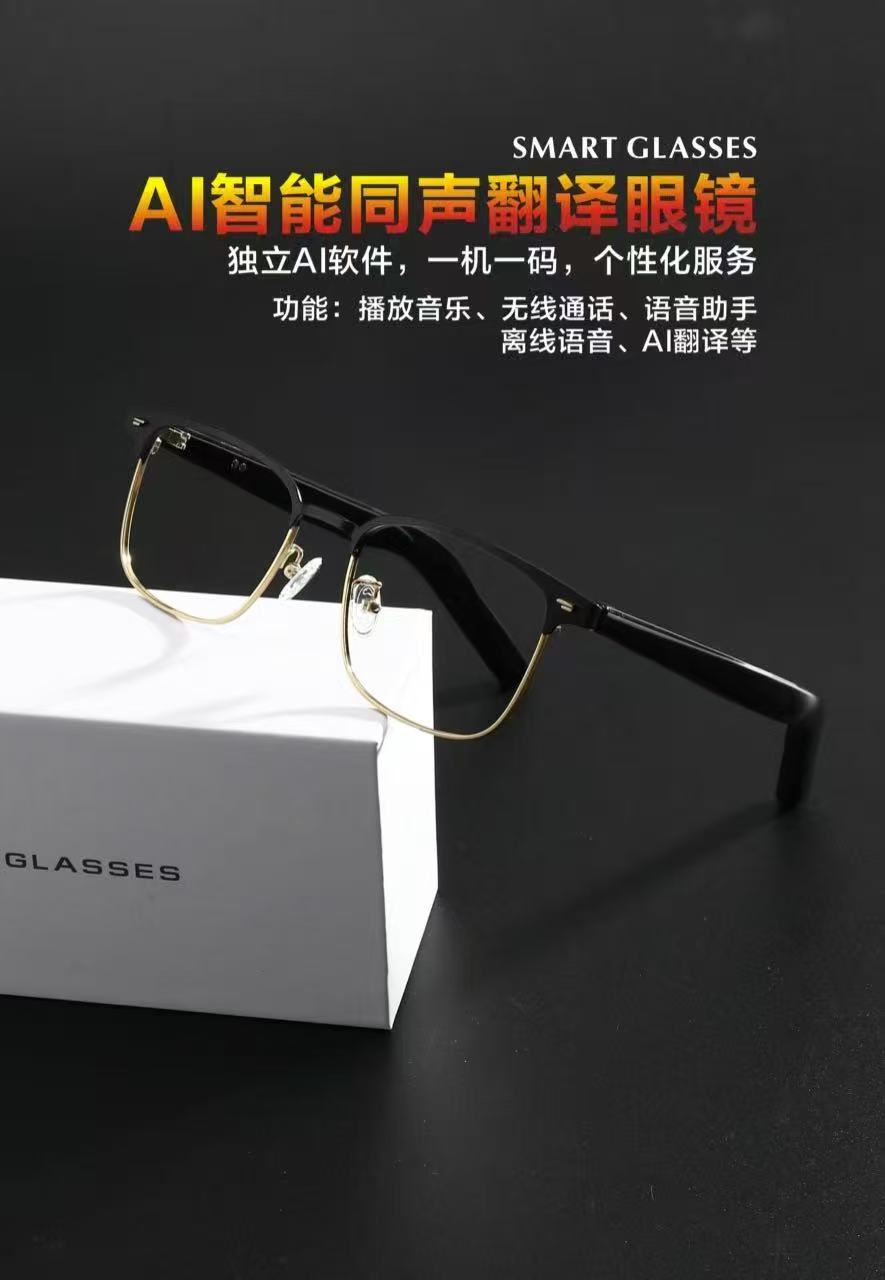

Translation Glasses: A World Without Language Barriers
When ordering at an izakaya in Tokyo, you no longer face the puzzle of kana and kanji—instead, Chinese dish names appear in real time. At a museum in Paris, the guide’s French narration transforms instantly into familiar text floating beside the exhibits. During an international video conference, your colleague’s English speech is accompanied by live subtitles, ensuring you never miss even the finest business details. This is the daily revolution brought by translation glasses—a world where language barriers are melting away.
The Silent Translator
The working principle of translation glasses is like that of an invisible simultaneous interpreter: built-in microphones capture speech, an AI engine processes it instantly in the cloud or locally, and a micro-projector on the lenses displays the translation as transparent text in the user’s visual comfort zone. Leading models today, such as Meta’s Ray-Ban Stories and Baidu’s AI glasses, can handle real-time conversation translation for over 40 languages, with accuracy exceeding 95% in common scenarios.
Three Revolutionary Experiences
Layer One: Information Accessibility
The most direct change is the democratization of information access. Whether it’s road signs, menus, documents, or spoken conversations, all information conveyed in an unfamiliar language becomes readable and understandable. This instant translation is not only fast (with delays typically under 0.5 seconds) but also maintains the fluidity of communication.
Layer Two: Naturalized Interaction
Traditional translation requires interrupting conversations to check devices, but translation glasses restore communication to its most natural state—maintaining eye contact, observing facial expressions, and responding in real time. This “invisible assistance” shifts cross-language interaction from a “technical process” back to the essence of “human connection.”
Layer Three: Cultural Penetration
The latest generation of products now integrates cultural context hints. When a Japanese person says “いただきます,” the glasses not only display “I will start eating” but also add a note in smaller text: “This expresses gratitude for the food and those who prepared it.” When an American says “break a leg,” you’ll see an explanation: “Good luck (theater slang).” This cultural-layer translation truly touches the soul of communication.