Online Monitoring Solution for Water Quality in Drinking Water Pipe Networks
Online Monitoring Solution for Water Quality in Drinking Water Pipe Networks
※ Abstract
Urban water supply pipe networks are complex, large-scale pipeline systems that serve as the lifeline of a city. As a crucial component of urban infrastructure, these underground networks ensure water supply for residential life, industrial production, public services, and other sectors. They also form the foundational information for urban planning, construction, and management by municipal authorities, and are essential for water supply enterprises to achieve "quality water supply and service to society." Effective July 1, 2012, China mandated the implementation of the new "Standards for Drinking Water Quality," which includes up to 106 testing indicators. Previously, water quality testing focused only on treated water leaving the plant; the new standards require that water at the point of delivery and from secondary supply systems also meet compliance.
※ Current Status of Drinking Water Pipe Networks
In recent years, water contamination incidents in drinking water pipe networks have occurred frequently across the country. Examples include the drinking water contamination incident in Huilongguan, Beijing, the contamination in Ruichang City, Jiangxi Province, and the water pollution incident in Xinhang Community, Huanggu District, Shenyang. In these events, residents in affected areas experienced physical discomfort and, in severe cases, required hospitalization. Additionally, aging pipe networks lead to rust, scaling, cracking, and leaks. Poorly sealed or unsealed water storage facilities in residential compounds and high-rise buildings have resulted in the presence of animal and plant remains, as well as accumulated garbage. Furthermore, the lack of timely maintenance, cleaning, and disinfection of pipe networks and storage facilities has led to significant water deterioration and contamination. These issues have heightened public concern over the potential safety risks associated with tap water, driving increasing demands for quality improvements.
As residents' expectations for drinking water quality rise, the stability and safety of urban water supply networks are gaining significant attention. Monitoring water quality to understand variations, predict changes, and control conditions has become a new development imperative for the urban water supply industry.
※ Essential Parameters for Pipe Network Water Quality Monitoring
Based on advancements in water quality monitoring and relevant national standards, the fundamental parameters that need to be measured in drinking water pipe networks are as follows:
1. Residual Chlorine
Residual chlorine refers to the amount of chlorine remaining in water after the added chlorine has reacted with bacteria, microorganisms, organic matter, inorganic substances, etc. If treated water lacks sufficient chlorine or the dosage is inadequate, bacteria, coliforms, and other microorganisms can proliferate within the pipe network, compromising water quality. Therefore, a certain level of residual chlorine must be maintained in the water supply network to ensure the microbiological safety of drinking water. China's "Standards for Drinking Water Quality" stipulate that residual chlorine should not be less than 0.3 mg/L after 30 minutes of contact time. For centralized water supply systems, while treated water must meet this requirement, residual chlorine at the network endpoint should not fall below 0.05 mg/L.
However, excessive residual chlorine concentration in tap water can lead to the following hazards:
- It is highly irritating and harmful to the respiratory system.
- It readily reacts with organic matter in water to form carcinogenic substances like chloroform.
The residual chlorine parameter ensures that the water remains effectively disinfected without developing an unpleasant odor.
2. Turbidity
Turbidity measures the degree of water cloudiness, indicating the presence of insoluble substances that reduce water clarity. These substances include suspended solid particles (such as sediment, corrosive matter, and planktonic algae) and colloidal particles. Turbidity depends not only on the concentration of suspended solids but also on their composition, particle size, shape, surface reflectivity, and quantity. It is a critical indicator for water quality. Reducing turbidity also reduces the presence of bacteria, coliforms, viruses, Cryptosporidium, iron, manganese, and other substances. Studies indicate that when turbidity is 2.5 NTU, approximately 27.3% of organic matter is removed. When turbidity is reduced to 0.5 NTU, organic matter removal reaches 79.6%. At 0.1 NTU, the majority of organic matter and pathogenic microorganisms are significantly reduced. For the water supply industry, turbidity is an extremely important parameter.
3. pH
pH is one of the most important and frequently measured parameters in chemistry, serving as a key indicator for water quality assessment. Although pH itself has no direct health effects, it influences other water quality parameters and treatment processes. Low pH can corrode pipes, while high pH can cause dissolved salts to precipitate and reduce the effectiveness of chlorination disinfection. Long-term consumption of water with excessively low or high pH can also negatively impact human physiology and health.
4. Conductivity
Conductivity is a measure of a solution's ability to conduct electricity. Generally, the higher the concentration of impurities in water, the greater its conductivity. Therefore, conductivity indirectly reflects the level of impurities present; purer water exhibits lower conductivity.
※ System Advantages
With the implementation and enforcement of the national "Standards for Drinking Water Quality," local governments are placing increasing emphasis on tap water quality, highlighting the importance of water quality parameter monitoring. An online drinking water quality monitoring system is an automated system installed at field locations. It continuously and automatically monitors changes in water quality, objectively records water conditions, promptly detects abnormal variations, and enables water quality reporting for the monitoring point. This system facilitates continuous monitoring of key parameters such as residual chlorine, turbidity, pH, and conductivity within the drinking water pipe network, aims to prevent water contamination incidents, and provides technical services and monitoring data to customers, water utilities, and relevant regulatory authorities.
- Enables Automated, Real-Time Remote Network Monitoring: It replaces traditional, labor-intensive, manual pipe network inspection and analysis. It overcomes the disadvantages of slow feedback and lack of timeliness associated with manual monitoring methods while significantly reducing manpower consumption. As water supply networks expand geographically, establishing a real-time, remote, accurate, and automated network monitoring system proves to be an effective solution.
- Achieves Real-Time Water Quality Monitoring of Pipe Networks: It provides continuous online monitoring of critical parameters essential for pipe network water quality, such as turbidity, residual chlorine, pH, and conductivity. This establishes an effective monitoring management mechanism and networked monitoring infrastructure. Essential water quality monitoring instruments and methods enable early detection of accidental water contamination events, reducing risks to the safety and health of the water supply network and drinking water.
- Provides Reliable Basis for Efficient and Stable Long-Term Network Operation: The system supplies historical water quality data reflecting the periodic health status of the pipe network. This data serves as a rational basis for decision-making regarding network operation, improving the timeliness and scientific basis of management decisions.
※ System Features
Based on the fundamental parameters required for water quality monitoring in drinking water pipe networks, establishing a multi-parameter online water quality analysis system with long-distance communication capabilities is essential for monitoring water quality across multiple areas.
To better serve drinking water pipe network safety, Shanghai NuoBo Environmental Protection Technology Co., Ltd. has launched a Multi-Parameter Online Water Quality Analysis System.
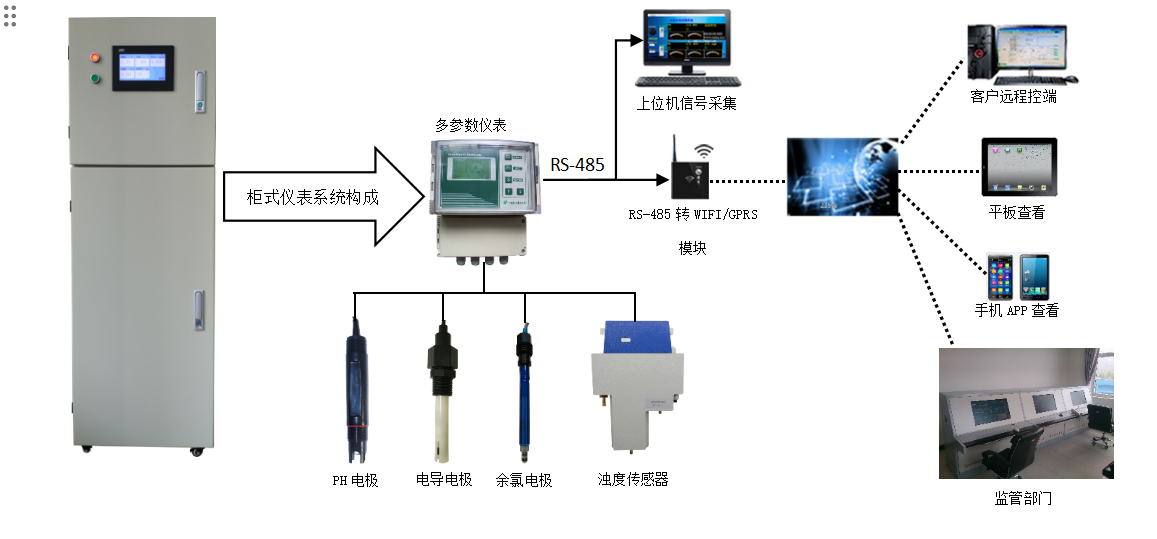
[Image Placeholder: System Diagram]
The system features the following characteristics:
- Real-time monitoring of water quality parameters: water temperature, pH, residual chlorine, turbidity, conductivity, etc. Different acquisition schemes are adapted based on varying environments to ensure data accuracy and long-term stability. The system can be integrated into a multi-parameter cabinet-style instrument.
- Equipped with an RS485 communication interface, facilitating real-time data management and viewing by users on-site via a host computer.
- The system consists of sensors/electrodes, transmitters (instruments), wireless modules, and other equipment.
- Remote data monitoring is supported. Data can be monitored locally over short distances via wired connections or transmitted wirelessly using WiFi, GPRS, or other modules for alarm notifications and data transfer over the internet. Computers or mobile devices can use relevant software (such as host computer software systems or mobile apps) for real-time online monitoring of corresponding drinking water pipe network monitoring points remotely. This also enables remote connection with relevant regulatory authorities, allowing users to receive timely alarms and conveniently store and access relevant data from remote locations.
自来水管网中水质在线分析的监测方案
※摘要 城市供水管网是结构复杂、规模巨大的管线网络系统,是城市赖以生存的血脉。作为保障居民生活、企业生产、公共服务等各方面用水的地下供水网管是城市基础设施的重要组成部分,也是城市管理部门进行规划、建设、管理的基础信息之一,更是供水企业实现“优质供水,服务社会”的提前。2012年7月1日起,我国强制实施新版的《生活饮用水卫生标准》,多达106项新国标检测指标,之前自来水只检测出厂指标,新国标则要求末梢水和二次供水同样达标。
※自来水网管现状 近年来,自来水管网水质污染事件在全国各地时有发生。如北京回龙观自来水污染事件,江西省瑞昌巿发生自来水受污染事件,沈阳市皇姑区新航社区水污染事件等事故,相关区域居民出现身体不适甚至重度住院的情况。加之自来水管网老化后生锈、结垢、破裂泄漏;小区、高楼等建筑蓄水设施密封条件差,甚至无密封措施,致使蓄水设施内出现动植物尸体、垃圾沉积;而自来水管网和蓄水设施常年得不到及时的维护、清洗和消毒,进而水体出现严重的变质和污染。使得人们对自来水资源所存在的安全隐患愈加担忧,要求不断提高。 随着各地居民对饮用水要求的不断提高,城市供水管网水质稳定性与安全性逐渐受到高度重视。通过水质监测技术监控管网水质变化、预测、控制水质情况,已成为城市供水行业发展的新需求。
※管网水质监控的基本参数 根据水质监测领域的发展和国家相关标准要求,自来水网管需要检测最近本的水质参数如下: 1.余氯 余氯是指将氯投入水中后,除了与水中细菌、微生物、有机物、无机物等作用消耗一部分氯量外,还剩下了一部分氯量,这部分氯量就叫做余氯。 如果出厂水没有氯或加氯量不够,在管网里就可能使细菌、大肠杆菌等微生物大量繁殖,影响管网水质,因此在供水管网中必须保证一定的余氯量。所以市政自来水中必须保持一定量的余氯,以确保饮用水的微生物指标安全。我国《生活饮用水卫生标准》规定:氯与水接触30分钟后应不低于0.3mg/L,集中式给水除出厂水应符合上述要求外,管网末梢水不低 于0.05mg/L。 此外自来水余氯浓度过高的话就会存在以下危害: 1、刺激性很强,对呼吸系统有伤害。 2、易与水中有机物反应,生成三氯甲烷等致癌物。 余氯指标就是要求水体经常保持有效的消毒 , 且又不致于有臭味。 2.浊度 浊度即水的浑浊程度, 它是水中的不溶性物质引起水的透明度降低的量度。不溶性物质包括悬浮于水中的固体颗粒物(泥沙、腐蚀质、浮游藻类等)和胶体颗粒物。它不仅与悬浮物的含量有关,而且还与水中杂质的成分、颗粒大小、形状及其表面的反射性能及含量多少有关。对于水至是一个至关重要的指标。 降低浊度的同时也降低了水中的细菌、大肠菌、病毒、隐孢子虫、铁、锰等。研究表明,当水中浊度为2.5NTU时,水中有机物去除了27.3%, 浊度降至 0.5NTU时,有机物去除了79.6%,浊度为0.1NTU时,绝大多数有机物与以去除,致病微生物的含量也大大降低。特别是对于自来水行业,浊度指标非常关键。 3.PH PH是化学中最重要、最经常的检测项目之一,是评价水质的一个重要参数,它虽然没有直接的健康效应,但会影响其它水质指标和水处理效果。过低的 PH值会腐蚀水管,过高会使溶解盐析出,降低氯化消毒作用。同时长期饮用PH过低或者过高的水也会对人体生理健康的造成一定的影响。 4.电导率 电导率是溶液导电能力的一个指标。一般水中杂质越多,水体导电能力越强。因此电导率值可以从侧面反映处水体杂质的多少;越纯净的水,电导率越小。
※系统优势 随着国家《生活饮用水卫生标准》颁布实施,各地政府对自来水的水质越来越重视,水质参数监测的重要性,日益显现出来。生活用水水质在线监测系统是设立在现场的水质自动监测系统。用于连续自动监测被测水体的水质变化情况,客观地记录水质状况,及时发现水质异常变化,进而实现对该供水点进行水质报告。达到掌握饮水管网水质余氯、浊度、 PH 、电导率等参数的连续监测,防治水污染事故,为客户、水务公司与相关监管部门提供技术服务和监控数据的目的。 1.实现自动化、实时远程管网监测。取代传统、繁琐、人工供水管网巡检分析,克服管网监测汇报反馈较慢,缺乏实效性的不利影响,同时可大大降低减少了人力消耗。随着供水管网不断增加,供水面积越来越大,建立实时、远程、准确、自动的管网监测系统是行之有效的办法。 2.实现对管网的实时水质监测。对管网水质最重要的核心关键参数浊度、余氯、 PH、电导率等进行实时在线监测,建立有效的监测管理机制和网络化监测设备。必要的水质监测仪表和手段,能及早发现意外的水质污染事故,减少危及到供水管网和饮用水的健康与安全事故的发生。 4.为管网高效长期稳定运行提供可靠依据。提供管网历史数据,反映管网水质阶段性健康状况,为管网运行提供合理的系统决策依据,提高了决策的及时性、科学性。 ※系统特点 根据自来水网管水质监控中所需检测的基本参数,在多区域监控自来水网管水质时就需要建立一套具备远距离通讯功能的多参数水质在线分析系统。 为了更好服务于自来水管网水质安全,广西君禾医疗器械有限责任公司面向市场推出了多参数水质在线分析系统。
该系统有以下特点: 1.可实时监控水质的参数:水温、PH、余氯、浊度、电导率等。根据不同环境配套不同的采集方案,确保数据的准确性和长期稳定性。并可集成为多参数柜式仪表。 2.具有RS485通讯接口,方便现场用户在上位机上实时管理和数据查看。 3.系统由传感器/电极、变送器(仪表)、无线模块等设备组成 4.数据远程监控,可有线短距离监控数据,也可通过wifi、gprs等无线模块,利用互联网进行报警通知和数据传输。电脑或移动设备可通过相关软件(如上位机软件系统、手机APP),远程对相应自来水管网监测点进行实时在线监控,并可与相应监管部门进行远程连接。方便用户在远端及时收到报警和相关数据的存储查阅。